What Does OF Mean in Text? Complete Guide with Examples (2026)
Ever stumbled upon the abbreviation “OF” in a text and wondered what it really means? In today’s digital world, understanding snippets of slang and shorthand is crucial for effective communication.
“What Does OF Mean in Text? Complete Guide with Examples (2026),” unpacks this popular acronym, providing clarity and context that can enhance your texting skills and improve your conversations.
READ MORE: What Does ISK Mean in Text? Full Meaning Explained Simply 2026
Why What Does OF Mean in Text Is Often Confusing in Digital Messages
Digital messaging, the phrase “of meaning in text” often leads to confusion. This confusion arises from the multifaceted nature of language itself. Context is king; without it, even the simplest phrases can take on unexpected meanings. A word can morph into an entirely different entity based on the relationship between the communicators and their shared experiences.
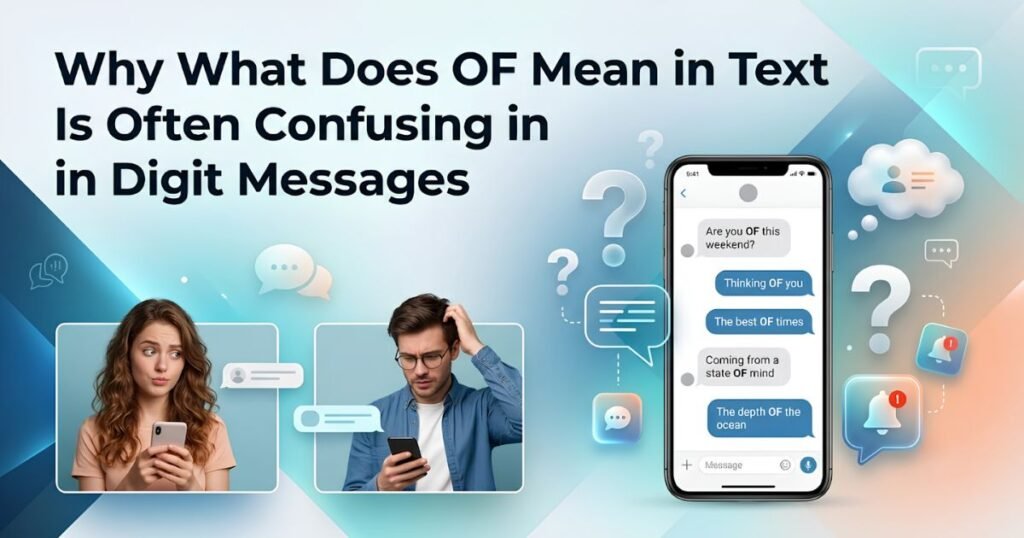
This semantic flexibility means that “of” can shift from a possessive indication to a mere filler, depending on the nuances surrounding it. The rise of abbreviated communication, think emojis, memes, and shorthand phrases adds another layer of complexity.
READ MORE: What Does GTS Means in Text? (2026 Updated Guide + Examples)
Core Meaning: OF as a Preposition in Text
The preposition “of” takes on a transformative role, shaping not just relationships between words but also the essence of meaning. When you dive into the of meaning slang, you uncover layers that are often overlooked. About how “of” connects identities, creating a rich tapestry that defines associations whether it’s “a group of friends” or “a state of mind.”

This simple word takes on profound implications, transforming a mere phrase into something that resonates on emotional and conceptual levels.
“Of” is a linguistic chameleon, adapting its significance based on context. In slang usage, it can signify belonging or a shared experience, as in “the vibe of the party” or “the heart of the city.” This subtle shift reflects the dynamic nature of language, where of meaning slang communicates and encapsulates cultural nuances.
Examples:
- “One of my buddies.”
- “The shade of your coat.”
- “An image featuring us.”
- “Send a photo of yourself, please.”
- “I’m a supporter of that concept.”
OF as Emotional Emphasis in Texting
Of takes on a unique role that transcends its traditional use. When someone types “of” as part of a phrase, it’s often a subtle cue, a way to amplify emotion without resorting to lengthy explanations. “I’m so tired of this,” can resonate more deeply than just the words themselves. The “of” evolves into a bridge connecting feelings and experiences, distilling frustrations into impactful snippets.
What is “of” in slang, we find that it often serves as a tool for solidarity. It’s the linchpin that binds individuals through shared experiences, packaging complex emotional states into bite-sized expressions.
“I’m over it, of course,” the “of” encapsulates the exasperation and a tacit understanding with the reader. It fosters connection, creating a communal space where shared sentiments flourish. This seemingly simple word becomes a powerful vehicle of emotion, thriving in the fast-paced world of digital communication.
Examples:
- “I’m fed up with this.”
- “I’ve reached my limit with this situation.”
- “I’m really in awe of your achievements.”
- “Your accomplishments truly inspire me.”
- “I can’t handle this anymore.”
- “I’ve run out of patience with this whole thing.”
- “I’m absolutely thrilled about your success.”
- “Your success brings me such joy!”
- “I’m so grateful for your help.”
- “I deeply appreciate your support.”
OF in Slang and Shortened Phrases
The world of slang and shortened phrases, “OF” emerges as a versatile gem. But what is OF? From social media to casual conversations, it often stands for “Original Flavour” or “Only Fans,” injecting life into discussions. This abbreviation showcases the evolution of language, where brevity meets creativity, allowing us to express complex ideas in a flash.
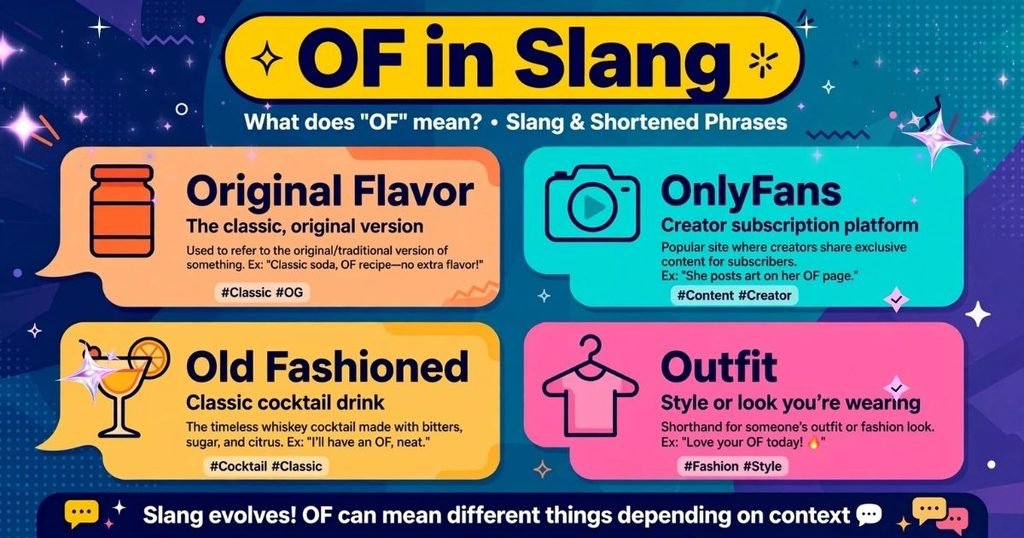
The cultural impact “OF” isn’t just a buzzword; it’s a lifestyle. It represents communities, tastes, and even exclusive content in the digital realm. The phrase transcends mere letters, turning into a badge of identity for those who resonate with its meaning.
As we navigate this linguistic landscape, we witness how “OF” captures a sense of belonging and authenticity, transforming everyday dialogues into vibrant exchanges.
Examples:
- “Sovereign of energy.”
- “Empress of disorder.”
- “Vibe of the moment.”
- “Monarch of the atmosphere.”
- “Goddess of unpredictability.”
READ MORE: What Does TS Mean in Texting? Full Slang Meaning Explained (2026)
OF as Part of Internet Phrases
The phrase “of” might seem trivial, but in the realm of internet slang, it transforms into a dynamic connector, enriching our digital lexicon. When paired with terms like “savage” or “clout,” it conjures phrases like “savage of the week” or “clout of the moment,” turning mundane descriptors into viral sensations.
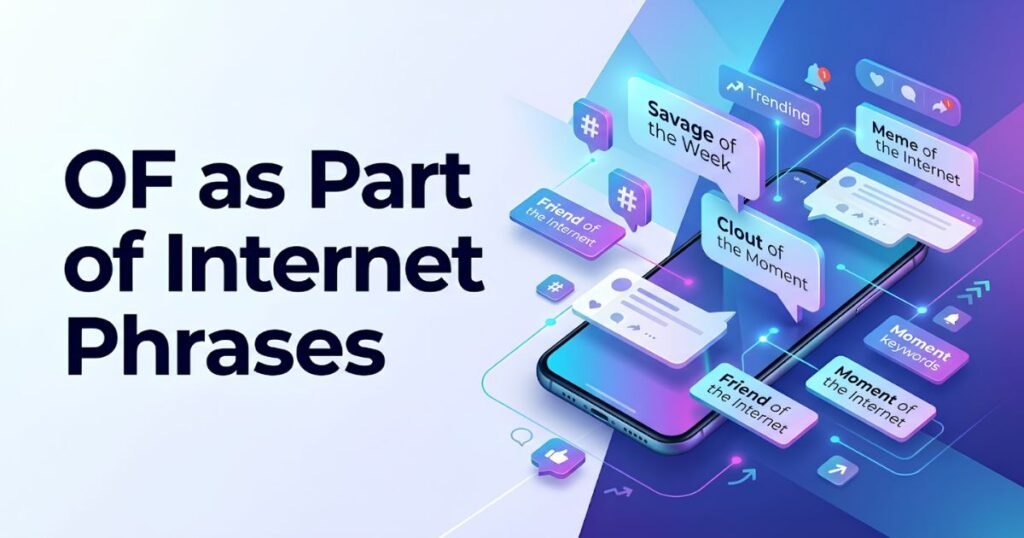
This subtle shift in usage reflects how language evolves online, adapting to convey nuanced meanings in instant conversations. The playfulness of “of” in phrases like “vibes of the summer” or “energy of the night” illustrates a cultural trend where distinct experiences are encapsulated into easily digestible snippets.
The versatility of the word, often overlooked, demonstrates how even the simplest terms are integral to shaping the rich tapestry of internet communication. Each new slang evolution reveals a deeper layer of connection among users, proving that every word carries weight in our fast-paced digital dialogue.
Some popular expressions are based on:
- “Just another one of those days.”
- “Wishing you the best.”
- “Sort of accurate.”
OF in Social Media Captions
Social media, crafting the perfect caption hinges on understanding the power of ‘OF’. This tiny preposition often unlocks deeper layers of meaning “the art OF storytelling,” for example. It transforms mundane posts into compelling narratives, connecting the audience to the emotion behind the image. When you share what is OF meaning in social media, you are essentially inviting followers to engage with your brand’s essence and identity.

Think of an influencer who posts breathtaking travel photos. Instead of merely stating, “I love this place,” they could say, “the joy OF adventure fuels my spirit.” This nuanced use of ‘OF’ enriches the experience, offering followers a glimpse into their world rather than a detached statement. The subtle complexity OF language, and watch as your social media presence transforms from ordinary to extraordinary.
Examples:
- “A day filled with bright rays.”
- “A visionary with grand aspirations.”
- “Adrift in a storm of ideas.”
READ ALSO: What Does WYLL Mean in Text? Real Meaning Explained 2026
OF vs “Off” — A Very Common Confusion
Understanding OF vs. “Off” is essential for both clarity and impact in communication. While they may seem interchangeable, their meanings diverge significantly. What is an OF? It’s a preposition that signifies relationships or belonging, often appearing in phrases like “the book of poetry.” “Off” indicates separation or a removal action, such as “take off your shoes.”
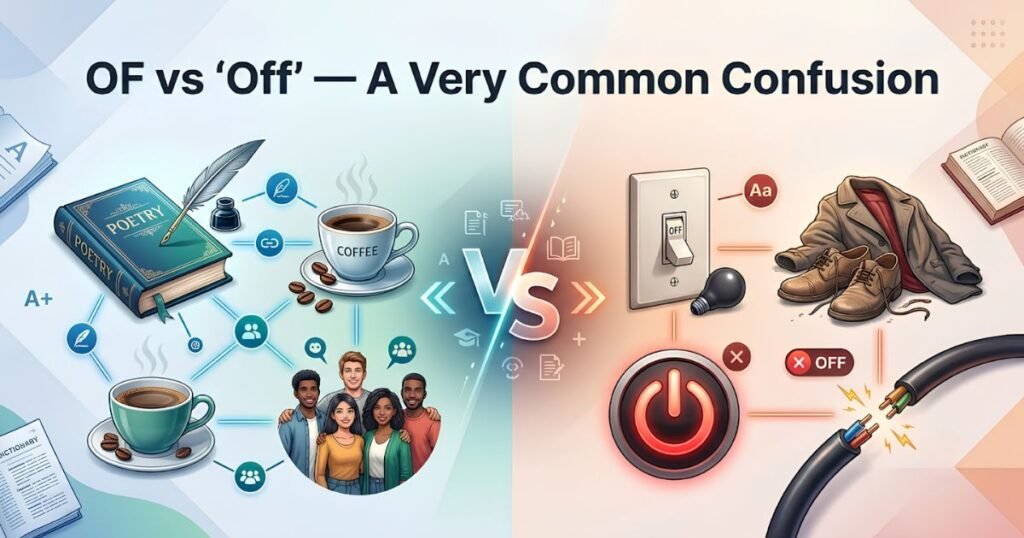
This distinction isn’t merely academic; misusing these terms can lead to confusion. Saying “the lid is off the jar” conveys a very different scenario than “the lid is of the jar.” Navigating these nuances enhances your writing and your verbal exchanges.
A lot of individuals confuse “of” and “off” when texting.
For example:
- “I’m tired of you.” → this is correct.
- “I’m tired off you.” → this is incorrect.
How Tone Changes the Meaning of OF
How tone changes the meaning of “of,” it becomes strikingly clear that context is everything. The phrase “the power of love.” The tone is one of warmth and connection, evoking feelings of affection and unity. Shift that tone: “the burden of love.” This alteration casts the same word in a completely different light, suggesting weight, responsibility, and even sadness.
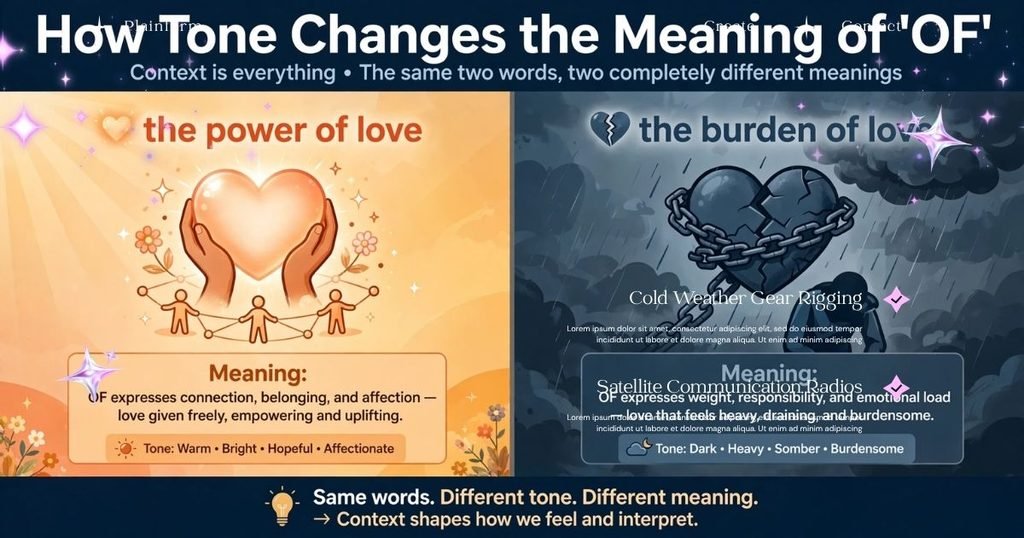
The versatility of the word “of” emerges in phrases like “the nature of reality” versus “the chaos of reality.” The former invites philosophical contemplation, while the latter conjures images of disorder and confusion.
This juxtaposition illustrates how tone can transform our and emotional response, emphasizing that what is of content depends heavily on delivery. Mastering tone allows us to wield subtlety in our language, unlocking layers of meaning waiting to be discovered.
Here’s your request reformulated in a different tone while keeping the meaning intact:
- Neutral:
- “A picture of the urban landscape.”
- Sarcastic:
- “Oh, fantastic, yet another city snapshot.”
- Romantic:
- “You’re on my mind.”
- Angry:
- “I’m fed up with this situation.”
OF in Texting Shortcuts and Fragments
Texting shortcuts have transformed the way we communicate, especially among younger generations. One such notable example is the slang “of,” which has evolved into a versatile fragment that can mean more than just a preposition.
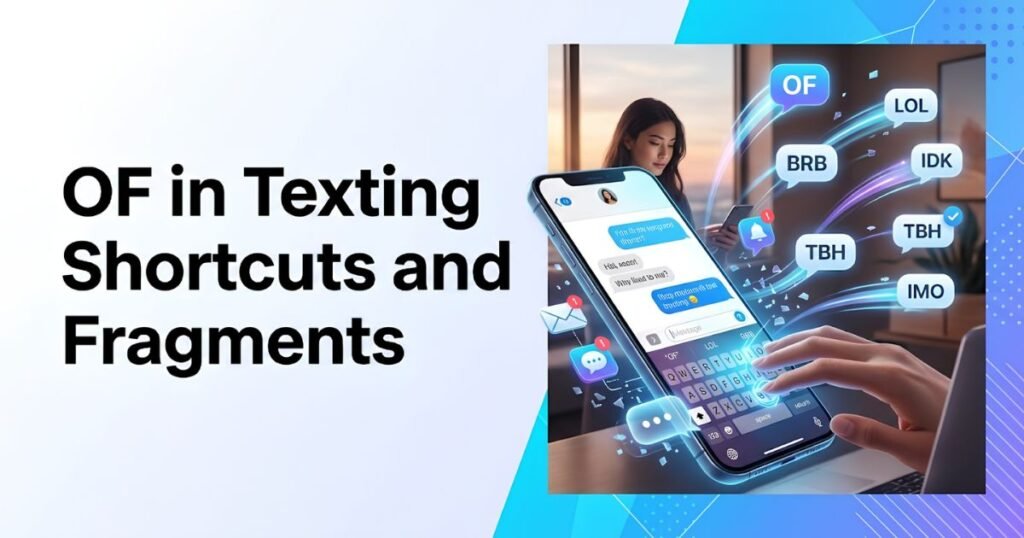
It becomes a playful stand-in for phrases like “of course,” transforming responses into concise affirmations. This evolution reflects a broader trend in digital communication where brevity reigns supreme.
The meaning of slang related to “of” is context-dependent. In group chats, a simple “of” can signify agreement, camaraderie, or even a shared inside joke.
Individuals frequently send messages in short phrases:
- “Exhausted from the wait.”
- “Over the drama.” (casual tone)
- “Brimming with energy.”
OF in Memes and Internet Humor
Memes and internet humour, “OF” has taken on a life of its own, evolving from a simple preposition to a cultural phenomenon. It captures the essence of playful absurdity, often linking unexpected phrases into something hilariously relatable.

This transformation exemplifies how language is fluid, constantly shifting to match the whims of digital expression. When you ask “what does OF mean in text?”, it’s not just about the word; it’s about the emotion and context that surround it.
Memes that juxtapose everyday scenarios with quirky “OF” combinations. Phrases like “I’m a fan of frogs” become comedic gold when paired with absurd visuals or surreal juxtapositions.
This unique form of humour taps into the collective consciousness of internet users, blending nostalgia and irreverence in one package. The magic lies in how “OF” serves as a bridge, connecting disparate ideas and showcasing the joy of shared experiences through humour.
Memes adore the phrases like:
- “Disaster’s chief.”
- “Group legend.”
- “Monday mayhem.”
OF Compared With Similar Words
What is “of”, it’s essential to recognize its unique function in English. This preposition often indicates a relationship or belonging, it stands apart from similar words like “from” or “about.” While “from” denotes a starting point or origin, “of” encapsulates a deeper connection think of “the heart of the city” versus “the city from which he came.”
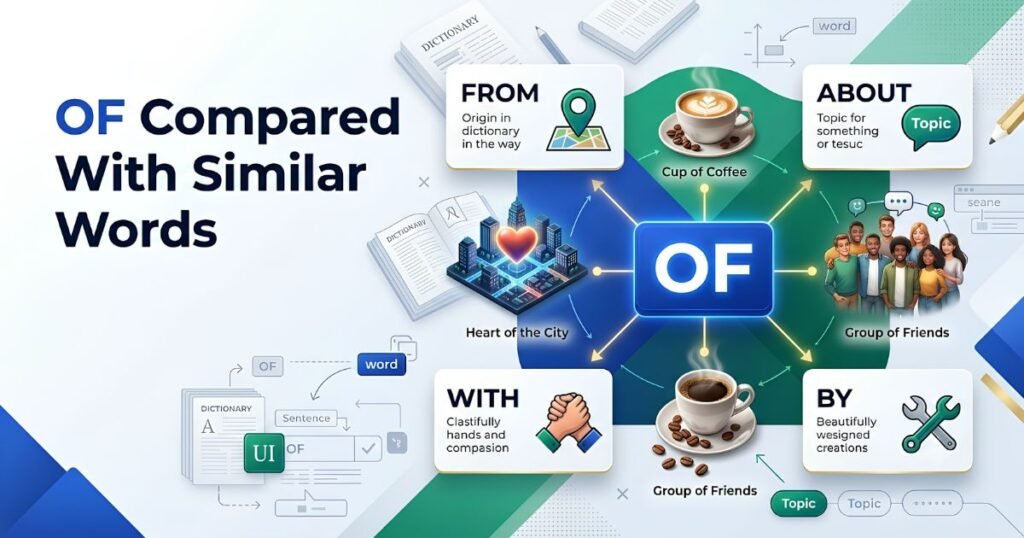
The former suggests an integral part of a whole, while the latter simply marks a physical location. The subtlety of “of” plays a crucial role in expressions of possession and identity. The first implies a profound relationship rooted in personal experiences, whereas the latter may seem transient or detached.
This distinction is vital; understanding what is “of” can enrich one’s writing and communication, allowing for a nuance that resonates on a more emotional level.
| Word | Function | Example | Tone |
|---|---|---|---|
| “Impressed by you” | Emotional | “Note from you” | Neutral |
| “Narrative about our journey” | Descriptive | “Present for you” | Straightforward |
When People Misuse OF in Text
When people misuse OF in text, it often leads to confusion and ambiguity. This seemingly innocuous preposition can dramatically change the meaning of a sentence. Saying “the love of my life” evokes intense emotion, while saying “the love for my life” shifts the focus to a self-centered perspective. These subtleties matter, especially in professional settings where clarity is crucial.
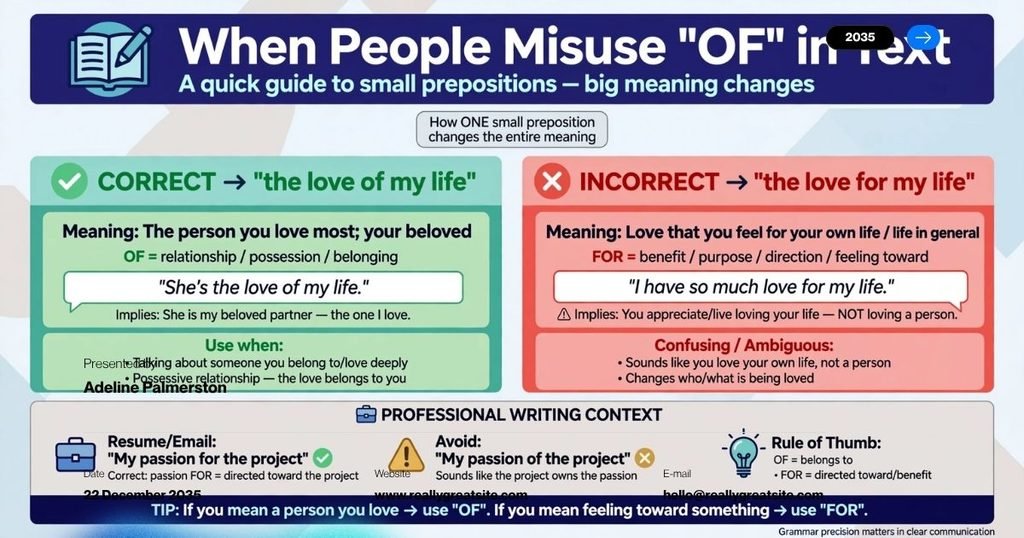
The misuse of OF often reflects deeper issues in communication skills. It detracts from one’s credibility and can make the writer appear careless or uninformed. In an era where first impressions are often formed through text, mastering the correct use of this simple preposition is vital.
Frequent errors:
- “Should have informed me.” → should have
- “Could have been aware.” → could have
Why OF Matters in Digital Language
In the dynamic realm of digital language, “of” takes on a surprising depth. Often viewed merely as a preposition, its use in slang reflects the fluidity and creativity characteristic of online interactions.
Terms like “of ign” (short for “of internet generation”) or “shook of” (expressing disbelief) showcase how this tiny word can encapsulate broader cultural narratives. Such expressions are not just about linguistic evolution; they embody a sense of belonging and identity in the digital age.
The meaning of slang like this is crucial for effective communication in virtual spaces. The use of “of” as a connector opens up avenues for expressing shared experiences and emotions, creating a unique bond among users.
How to Read OF Correctly in Any Message
The “of” meaning in any message is crucial for decoding intentions and emotions. This seemingly simple preposition can carry deep implications and nuances. When reading, pay attention to the context who is using “of” and why it influences the sentiment. “the power of love” resonates differently than “the burden of responsibility.”
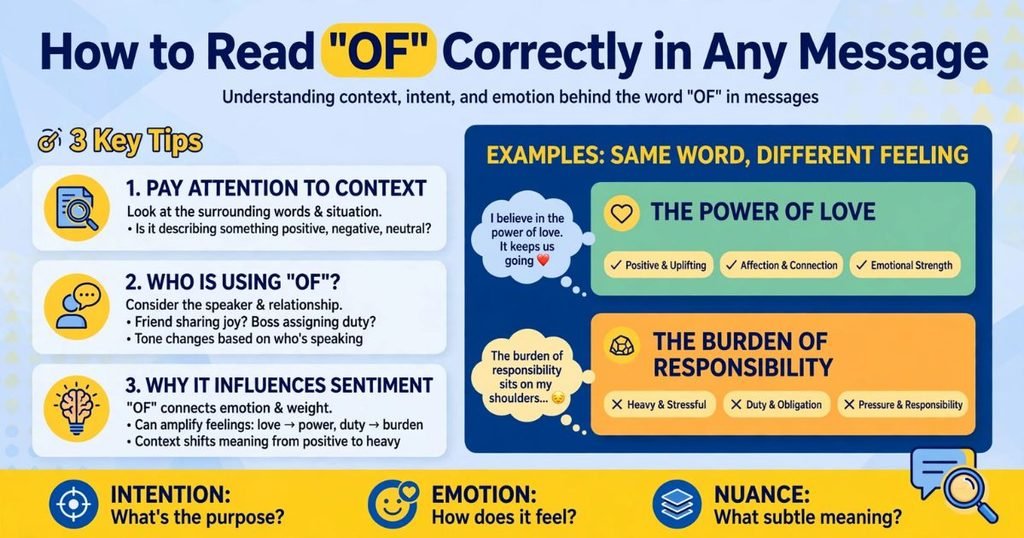
Delve deeper into the layers behind “of”. It often indicates possession, connection, or a relationship. When you encounter phrases like “the secrets of success,” what that implies possession, a journey intertwined with obstacles and achievements.
Pose three inquiries:
- What preceded this?
- What follows it?
- How would you describe the conversation’s mood?
Example:
- “Fed up with this.” → annoyance
- “Missing you.” → fondness
- “Image of you.” → portrayal
How to Use OF in Your Own Texts
Using OF in your writing fosters depth and clarity. When you weave OF content into your texts, you’re not just filling space; you’re adding layers of meaning. Think of phrases like “the beauty of nature” or “the essence of creativity.” They guide readers to understand specific relationships and evoke strong imagery.

The nuances of OF by contrasting it with similar prepositions. “the sound of music” creates a sensorial connection, while “the sound from music” shifts the focus. Using OF can enhance emotional resonance phrases like “the pain of loss” that encapsulate complex feelings into a succinct expression.
Safe Example:
- “Impressed by your accomplishments.”
- “Appreciative of what you do.”
- “Brimming with creativity.”
OF in Romantic Texting
Romantic texting, the significance of “of” transforms into something more than a mere preposition. This tiny word often embodies a deeper emotional connection. When used in phrases like “I think of you” or “Dreaming of us,” it transcends its grammatical role, serving as a bridge between hearts.

The ‘of’ meaning slang captures this essence, encapsulating longing and intimacy in just a couple of characters. The casual nature of texting means that emotional layers can sometimes get lost in translation.
Someone types “I’m proud of you,” they’re expressing admiration; they’re weaving in personal investment and shared experiences. This form of romantic communication underscores how textual nuances can refine emotional exchanges, deepening the bond even through screens.
Expressions of affection frequently include phrases like:
- “Having you on my mind this evening.”
- “Impressed by how far you’ve come.”
- “Thankful for having you around.”
ALSO READ: What Does DP Mean in Text? Full Meaning Explained Simply 2026OF in Friendly Chats
Friendly chats, the of meaning can be a playful exploration of connection. When friends dip into conversations, words become a vessel, carrying layers of intention and emotion. The simple phrase “I’m proud of you” transcends mere compliment; it transforms into a celebration of growth and effort.
Recognizing the weight behind such words elevates the interaction from small talk to a sincere exchange, strengthening bonds and fostering deeper understanding. How context shapes the meaning of our dialogues.
A shared laugh over an inside joke perfectly illustrates the magic of the moments that knit friendships together. It’s these nuanced layers, enriched with personal history and shared experiences, that breathe life into our chats.
Everyday expressions:
- “Really enjoy that.”
- “Somewhat amusing.”
- “Exhausted from the job.”
OF in Professional Texts
In the realm of professional texts, the phrase “of” may appear mundane, yet it serves as a linchpin for clarity and cohesion. What is an ‘of’? It’s more than just a preposition; it connects ideas, contextualizes concepts, and establishes relationships.
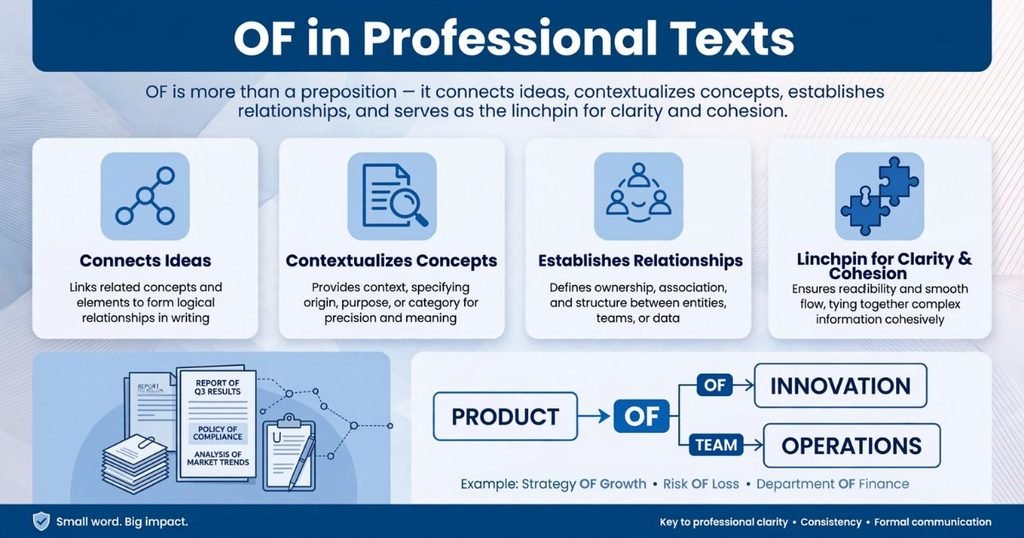
Whether linking titles to authors in academic papers or denoting ownership in business documents, this little word packs a potent punch, ensuring that meaning is not lost amidst complex jargon.
The significance of specificity. In a professional setting, precision is paramount. The “of” seamlessly ties information, guiding the reader through intricate relationships. The phrase “the impact of leadership on team dynamics” does more than inform it invites exploration.
Improved options:
- Rather than expressing “I’m fed up with this,” you could articulate:
- “I have reservations about this matter.”
READ ALSO:What Does “HY” Mean in Text? Full Meaning, Uses & Examples (2026 Guide)
Psychological Meaning Behind OF
Psychology, the phrase “what does OF mean” transcends mere semantics. It delves into the structure of thought and the connection between experiences and identity.
The word “of” establishes relationships, layers meaning, and often serves as a bridge between the self and the world. It signifies possession, belonging, and association crucial elements in how individuals conceptualize their reality.
The implications, “of” reveals deeper truths about attachment and perception. We say “part of my journey” or “fear of loss,” we are naming experiences; we are entwining them with our identities. This connection underscores the human experience of relationality; our thoughts are rarely isolated, but instead, they resonate within a web of influences and emotions.
When individuals express:
- “I admire what you’ve accomplished.”
- This conveys affirmation and a sense of bond.
When they express:
- “I’m fed up with this.”
- They’re indicating their limits and feeling emotionally drained.
Cultural Layer of OF in Language
The cultural layer of OF in language is a fascinating intersection where identity meets expression. Slang isn’t merely a collection of words; it embodies the vibrancy of a community’s shared experiences and values.

Term or phrase carries weight, reflecting socio-political contexts, generational gaps, and even the nuanced emotions tied to specific cultures. Words popularized through social media can evolve rapidly, providing a unique lens into the mindset of today’s youth, driven by viral trends and content creators.
The slang meaning within these cultural frameworks allows us to appreciate diversity in communication. It reveals how language shifts, adapts, and survives in different environments, resonating with collective memories or emerging social phenomena.
This linguistic evolution encourages a deeper dialogue about our shared humanity while also highlighting disparities in expression challenging us to bridge gaps between contrasting communities. Each term adopted or adapted speaks volumes about belonging, power, and the ever-shifting tides of cultural identity.
READ MORE: What Does LCR Mean in Text? Simple Meaning, Uses, and Examples 2026Frequently Asked Questions
What does “of” Stand for in Texting?
In texting and online communication, “of” is often abbreviated as “o”. This simplicity enhances the speed of messaging, making it easier to convey thoughts quickly. This kind of shorthand is especially common in casual conversations, where brevity is key.
What does 0f Stand for?
0f often refers to 0 degrees Fahrenheit, a temperature scale used primarily in the United States. Developed in the early 18th century by Daniel Gabriel Fahrenheit, the scale sets the freezing point of water at 32°F and the boiling point at 212°F.
What is 0f in Slang?
“0f” often refers to the term “off.” It’s commonly used in various contexts, especially in online gaming and digital communication, to indicate that something is not functioning or out of order.
What does “of” Mean Online?
The term “of” in online conversations can convey a range of meanings depending on context. Generally, it signifies ownership or association. “User of,” they’re indicating that a particular person utilizes or belongs to a specific service or platform.
What is the Full Meaning of “of”?
The word “of” is a preposition used to indicate relationships, possession, or origin. It connects nouns, showing a link between them. When we say “the book of John,” it signifies that John possesses the book or that the book is related to him.
Conclusion
What OF means in text can significantly enhance your digital communication skills. This abbreviation, often used to convey sentiment or context in a more concise manner, is prevalent across various messaging platforms. Yourself with its usage and the nuances it carries, you can avoid misunderstandings and convey your messages more effectively.
Staying updated with linguistic trends enriches your conversations and keeps you connected with contemporary culture. The next time you come across OF in a chat, you’ll know exactly how to interpret it!